
Important Pipeline Safety Information for Residents, Landowners, Farmers and Schools

You have received this because you live, work or own property near a pipeline owned or operated by Pembina U.S. Corporation or one of its affiliates (Pembina U.S.). Please use this important information about pipeline safety to keep your communities safe and prevent damage to pipelines.
As part of our Public Awareness Program, we are committed to informing and educating you about the presence of pipelines in your community and how to work safely around them.
Read on to find out about our operations, safety practices and how you can help to prevent damage to underground infrastructure in your area.
About Pembina U.S.
We are a leading North American transportation and midstream service provider. For 70 years, we have been safely and reliably connecting oil, natural gas, and natural gas liquids production to markets that need it. Pembina U.S. owns an integrated system of pipelines that transport various hydrocarbon liquids and natural gas products. We also own gas gathering and processing facilities, and an oil and natural gas liquids infrastructure and logistics business.
U.S. PIPELINE SYSTEMS
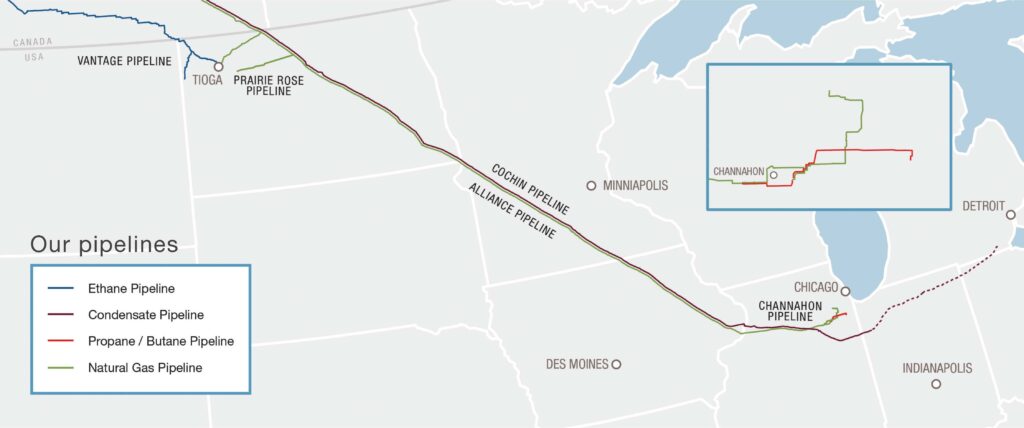
In 2019, Pembina U.S. acquired ownership of the U.S. portion of the Cochin Pipeline System, which transports condensate, from Kinder Morgan. The U.S. portion of the Cochin Pipeline System is owned and operated by Pembina Cochin LLC, an affiliate of Pembina U.S. Corporation. The U.S. portion of the Vantage Pipeline and the West Spur Lateral pipelines are high vapor pressure (HVP) pipes that transport ethane. Vantage Pipeline US LP (Vantage) is the owner and operator of the Vantage Pipeline and the West Spur Lateral. Vantage is an affiliate of Pembina U.S. Corporation.
Pembina U.S. is an indirect partial owner of Aux Sable, in partnership with Williams. Aux Sable is physically operated by a Pembina U.S. subsidiary, and includes the Channahon Pipeline, which is a HVP propane / butane pipeline, and the Prairie Rose Pipeline, which is a HVP natural gas pipeline.
The Alliance Pipeline system consists of a 2,391-mile integrated Canadian and U.S. natural gas transmission pipeline system, delivering rich natural gas from the Western Canadian Sedimentary Basin and the Williston Basin to the Chicago market hub. The system has been in commercial service since December 2000 and, through an innovative suite of customer-focused services, delivers an average of 1.6 billion standard cubic feet (or 45.3 million standard cubic meters) of natural gas per day.
What is condensate?
Condensate is a low-density mixture of hydrocarbon liquids. It is typically used in heavy oil production. Because condensate is typically liquid in ambient conditions and also has very low viscosity, it is often used to dilute highly viscous heavier oils that cannot otherwise be efficiently transported via pipelines.
What is ethane?
Ethane is a hydrocarbon that is isolated from natural gas. The petrochemical industry uses raw materials such as benzene, ethane, and propane from the oil and gas industry to manufacture products that we use every day. The Vantage Pipeline and the West Spur Lateral transport ethane, which is most commonly used to produce ethylene and polyethylene. These chemicals are needed to manufacture products like plastic, automotive antifreeze, and detergent.
What is fuel gas?
Fuel gas is a component of natural gas and is composed primarily of methane. Fuel gas is used to power natural gas engines and generators, and in various industrial applications.
What is propane/butane?
Propane and butane are hydrocarbons isolated from natural gas. The petrochemical industry uses raw materials such as propane and butane to manufacture products that we use every day. Propane and butane is used for cooking and heating. Butane is also used as a refrigerant and as propellant in aerosol cans.
PIPELINE RELIABILITY
We are a leading North American transportation and midstream service provider.
For 70 years, we have been safely and reliably connecting oil, natural gas, and natural gas liquids production to markets that need it. Pembina U.S. owns an integrated system of pipelines that transport various hydrocarbon liquids and natural gas products. We also own gas gathering and processing facilities, and an oil and natural gas liquids infrastructure and logistics business. Pembina U.S. is focused on pipeline safety and maintaining the integrity of our pipelines. We know that maintaining the integrity of our condensate and ethane pipelines is essential to the health and safety of the communities where we operate. That’s why we’ve developed, and are continuously improving, processes and programs to monitor our pipelines.
Pembina U.S. ensures our pipelines and facilities are designed, constructed, and operated in a safe and environmentally responsible manner. We develop stringent standards and review potential hazards, in addition to conducting regular safety meetings, contractor screenings, and inspections.
Pembina U.S. conducts regular inspections, maintenance, and testing to confi rm that pipelines are operating safely. Pipelines are monitored 24/7/365 from a control room using sensors that monitor flow and operating conditions. We also use in-line tools and aerial inspections for constant surveillance.

How to obtain more information about pipelines and pipeline operators where you work or live.
The National Pipeline Mapping System (NPMS) is an online mapping tool available to the public that enables you to view information on transmission pipelines that are under Department of Transportation (DOT) and Pipeline and Hazardous Materials Safety Administration (PHMSA) jurisdiction. By accessing the NPMS, you can view information on a county by county basis and obtain information on which transmission pipelines operate in your community. You can also obtain contact information for pipeline operators in your area. The NPMS can be accessed at: https://www.npms.phmsa.dot.gov/
Remember: The NPMS is not to be used to identify exact locations of pipelines. You must contact the local One-Call system before you start any digging activities.
A PIPELINE RIGHT-OF-WAY
A pipeline Right-of-Way (ROW) is the strip of land where the pipeline is located. The width of the ROW may vary depending on factors such as pipeline diameter and the slope of the land. The ROW enables Pembina U.S. employees and representatives to access the pipeline for inspections, maintenance, testing, and in the rare event of an emergency.
Pembina U.S. keeps pipeline ROWs free of obstructions like trees, shrubs, fences, and buildings for one reason – safety. Keeping the ROW free from obstructions and encroachments allows for access to the pipeline without interference and is essential for pipeline integrity, monitoring (by aerial or foot patrol), and safety. Generally, landowners agree to give companies the rights to the ROW for the construction, operation, and maintenance of the pipelines; however, ownership of the land remains with the landowner.

HOW DO YOU KNOW THERE IS A PIPELINE NEARBY?
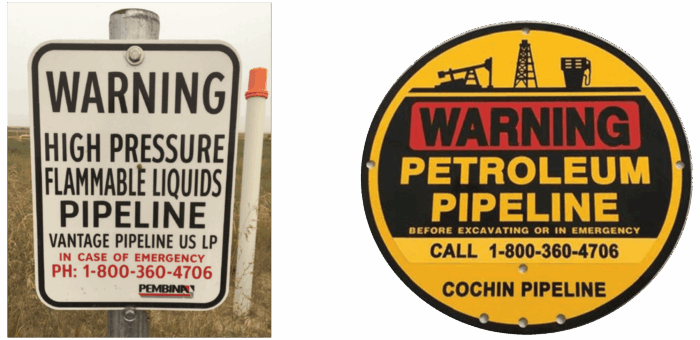
Line markers and warning signs are used to indicate the presence of the underground pipeline in frequent intervals along the ROW. Here are some examples of our signage for the Cochin and Vantage systems:
Pipeline markers only show that a pipeline is present. Pipeline markers do not show the exact location of the pipeline. Pipeline locations within a ROW may vary along the length of the ROW. Additionally, there may be multiple pipelines located in the same ROW. Before digging in the area, you must call your local One Call Center at 8-1-1 or ensure the underground pipelines are accurately marked.
KNOW THE WARNING SIGNS
Although rare, it is important to know the warning signs of a pipeline release:

You might see:
- dead or dying vegetation in an otherwise green area
- dirt being blown or appearing to be thrown into the air
- a white vapor stream or mist-like cloud over the pipeline
- unexpected frost or ice on the ground
- discolored snow or vegetation
- a moist patch or pool of clear, light brown or yellow liquid
You might hear:
- an unusual hissing, blowing or roaring noise
You mights smell:
- a petroleum or hydrocarbon smell similar to gasoline or diesel fuel
PRODUCTS HAVE DIFFERENT CHARACTERISTICS IF RELEASED
- Ethane enters the atmosphere as a hazardous and flammable gas. Contact with ethane may cause skin irritation and/or frostbite. Exposure to ethane may cause headache, dizziness or nausea. At very high concentrations, ethane can cause suffocation due to the lack of oxygen in the air.
- Condensate is a hazardous and extremely flammable liquid. Contact with condensate may case headache, nausea, dizziness, skin and eye irritation.
- Fuel gas is extremely flammable and may cause suffocation. If you feel unwell, seek medical attention immediately. Contact with rapidly expanding or liquified gas may cause skin irritation and/or frostbite
- Propane is an extremely flammable product. Propane vapors may travel long distances to a point of ignition and then flash back. Exposure to skin may cause frostbite, blisters, tingling pain and/or numbness.

IF YOU SUSPECT A RELEASE
You are our partner in safety
In the unlikely event of an emergency, Pembina U.S. will shut down the pipeline (if necessary) and activate our Emergency Response Plans.
What to do:
- abandon any mechanized equipment and move as far away from the leak as possible, avoiding contact with escaping liquids and gases
- call 9-1-1
- call Pembina U.S.’s emergency line that you see on a pipeline marker
- follow instructions provided to you by Pembina U.S. and local emergency responders
What you shouldn't do:
- do not touch or go near any liquid, gas or vapor cloud do not start your vehicle or any equipment that could be a potential ignition source
- do not smoke or light a match, and avoid heating sources or making sparks
- do not turn on or off anything that may create a spark, including cell phones, pagers, flashlights, keyless entry remotes, vehicle alarms, and light switches, until you are in a safe location
- do not attempt to operate or turn pipeline valves
- do not attempt to extinguish any flames or fire
- do not remain in a building if the smell is stronger inside than outside
What happens next:
- Public safety is top priority while Pembina, contractors and local emergency responders work together to evaluate and respond to a pipeline leak
- Local emergency responders oversee public safety measures including securing the scene, providing medical aid and other lifesaving services and getting you the information you need to stay safe
- Pembina will work with applicable agencies to remediate any impacts caused by the leak
SAFETY IS A SHARED RESPONSIBILITY
Pipelines are designed and constructed to be safe
Pembina U.S. takes many steps to ensure safe and reliable operations which include a strict adherence to both an Integrity Management Program and Damage Prevention Program for continuous monitoring and maintenance. Damage from third-party excavation and construction activities around pipelines is the most common cause of damage to pipelines. That’s why safety is a shared responsibility and members of the digging community and the public have a responsibility to help protect pipelines from damage.
How you can help
If you notice any unusual or suspicious activity on or near the ROW, please report it by calling 9-1-1 and Pembina U.S.’s 24-hour emergency number: 1-800-360-4706
- Emergency number for Aux Sable, North Dakota: 701-628-9393
- Emergency number for Aux Sable, Illinois: 815-941-5858
- Emergency number for Alliance (US & Canada): 1-800-884-8811
Describe specifically what you observed, including:
- who or what you saw
- when you saw
- where it occurred
- why it’s suspicious
Although rare, emergencies can occur. To prepare for these instances, Pembina U.S. participates in an Emergency & Continuity Management Program (ECMP), which includes comprehensive standards and processes to support the safety of the public, our workers and the environment.
The ECMP evaluates potential hazards from our operations as well as other hazards such as security breaches and natural disasters. Our comprehensive evaluation provides the foundation for our approach of prevention, planning, response and recovery. This approach allows for a safe and effective response to an incident.
Emergency Response Plans are maintained for Pembina U.S.’s facilities and products. These plans identify the organizational structure, equipment, and resources necessary to ensure that actions are taken for the protection of the public, employees and the environment.
Pembina U.S. conducts ongoing responder training, exercises, and public consultation to ensure continuous improvement of our plans and program and that our personnel are ready to respond to emergencies.
KNOW THE DANGERS AND WHAT YOU CAN DO TO ENSURE YOUR SAFETY
Unauthorized crossing or digging activities along right of ways pose serious threats to pipelines that may result in harm to workers, the environment, and the safety of others nearby. Damage from third-party activities is a leading cause of pipeline incidents and that can include damage from farming equipment and agricultural activities. To protect people and the environment, and to reduce the risk of pipeline damage, state and federal laws require anyone planning to excavate near a pipeline ROW to call their local toll-free One Call number or call 8-1-1 in advance of any ground disturbance activity.
These activities, among others, can pose a risk to pipelines:
- landscaping
- planting a tree
- installing fence posts or building a fence
- fixing or improving an existing ditch, drain tile, or fence
- building a berm
- constructing roads, paving, parking, driveways, ditches, railways, overhead or underground utilities
- altering the grade
- deep tilling or ripping
- installing drain tile
- operating non-agricultural equipment or other vehicles on or over the ROW (such as ATVs and snowmobiles)
Before conducting any work near a pipeline or ROW, please remember to contact your local one-call centre to have the pipeline located free of charge.
BEFORE CONDUCTING ANY DIGGING ACTIVITIES, FOLLOW THESE STEPS
- Know where buried pipelines are located. Pipeline markers are signs found along the right of way, such as at road or river crossings, to identify approximately where the buried pipelines are located. However, these markers should not be solely relied on for the exact location, path or depth of a pipeline.
- Always contact your local One Call Center at at least 2-3 business days prior, or as indicated by your local One Call Center, before digging or conducting any ground disturbance near buried pipelines by phoning 8-1-1.
- Wait until the lines are marked before digging. Upon receipt of a locate request, the One Call Centre will notify the pipeline operator(s) in the vicinity of the digging project. Pembina U.S. will contact you to determine next steps. Sometimes, Pembina U.S. may require that any excavation near its pipelines be monitored by qualified personnel. The risk of excavation damage to pipelines can be reduced when qualified personnel familiar with the pipeline system monitor excavations.
- Follow the instructions of an authorized pipeline operator representative. Don’t take any actions until you are absolutely sure you will not impact a buried pipeline and then follow the instructions from an authorized pipeline operator representative.
- Report any damage to Pembina U.S. immediately. Damage to pipelines could result in service disruptions, environmental impacts, serious injuries, or potential loss of life. Report damage by contacting Pembina U.S. as soon as possible at:
- Pembina U.S.’s 24-hour emergency number: 1-800-360-4706.
- Emergency number for Aux Sable, North Dakota: 701-628-9393
- Emergency number for Aux Sable, Illinois: 815-941-5858
- Emergency number for Alliance (US & Canada): 1-800-884-8811
Before conducting any work near a pipeline ROW, always contact your local One Call Center to have the pipeline located free of charge. Consent from Pembina U.S. may be required prior to starting work.
PREVENTING DAMAGE TO PIPELINES DURING AGRICULTURAL ACTIVITIES
Farmers and ranchers play an important role in protecting pipelines from damage and must contact the local One-Call Center before conducting any soil disturbing activities that are not considered an agriculture activity.
What is considered an agricultural activity?
Agricultural activity is defined as the production of crops and the raising of animals, and includes tilling / fallowing, herbicide application, harrowing, livestock feeding, seeding, fertilizer application, harvesting, mowing, haying, spreading of manure
Agriculture activities are permitted on or near a pipeline ROW as long as depth of cultivation is less than 18 inches. Written consent from Pembina U.S. and a One-Call notification may be required for non-agricultural activities.
Note that heavy rains, floods, and droughts can affect the soil above buried pipelines. If you spot soil erosion or displaced soil along a ROW, please contact Pembina U.S. immediately.
VEHICLES AND MOBILE EQUIPMENT
Unless an agricultural activity, crossing the pipeline with a vehicle or mobile equipment (outside of a traveled portion of a highway or public road) must have Pembina U.S.’s written consent to do so. Pembina U.S. will determine if the vehicle is safe to cross our pipelines.
Once we’ve evaluated the request and confirmed whether or not the vehicle may cross safely, we will provide the necessary written consent or work with you on modifications as required.
DRAINAGE IMPROVEMENTS
Consulting with us as early as possible regarding your drainage proposal, including installing drain tiles, ditching, grading or deep tilling will allow us to assess your work and set safe work procedures when working within the pipeline ROW.
If landowners are unsure if their activity is an agricultural activity, or if the agricultural activity could jeopardize the safe and secure operation of the pipeline, please contact Pembina U.S. before crossing or performing any ground disturbance work.
OBTAINING WRITTEN CONSENT FOR A CROSSING OR GROUND DISTURBANCE
If an individual or company plans to cross, dig, or excavate on the pipeline ROW, application and approval for written consent is requested prior to the start of work.
Crossing or Ground Disturbance agreements are written approvals from the pipeline owner. They inform pipeline operators about upcoming crossings on, along or underneath the pipeline ROW, temporary crossings with vehicles or equipment or excavations on the ROW.
Please contact Pembina U.S. for written consent if you anticipate needing to cross or dig near the ROW by following these steps:
- Email landrequests@pembina.com with your name, land description and the scope of the work you would like to do.
- Pembina U.S. will contact you and walk you through how to submit a request for consent.
- Pembina U.S. will review the request. Once your information has been assessed and potential impacts have been evaluated, Pembina U.S. will respond and may:
- grant consent that requires certain conditions to be met to assure safety
- work with you to find solutions and resolve issues or concerns regarding the consent request.
Once consent has been granted, then you must:
- make a locate request by contacting your local One Call Notification Center at least 2-3 business days, or as indicated by your local One-Call Notification Center, before beginning the work
- arrange for a representative from Pembina U.S. (contact information will be provided in the written consent) to be on site to inspect the area at time of activity
- keep written consent and documentation onsite at all times
Once consent has been granted, then you must:
- make a locate request by contacting your local One Call Notification Center at least 2-3 business days, or as indicated by your local One-Call Notification Center, before beginning the work
- arrange for a representative from Pembina U.S. (contact information will be provided in the written consent) to be on site to inspect the area at time of activity
- keep written consent and documentation onsite at all times
If you have any additional questions, please contact Pembina U.S. at landrequests@pembina.com and we will work with you to answer your questions.
24 HOUR EMERGENCY LINE: 1-800-360-4706
Emergency number for Aux Sable, North Dakota: 701-628-9393
Emergency number for Aux Sable, Illinois: 815-941-5858
Emergency number for Alliance (US & Canada): 1-800-884-8811
If you notice any unusual or suspicious activity on or near the pipeline or Right-of-way (ROW), please report it by calling 9-1-1 and Pembina U.S.'s 24-hour emergency number above.
CALL BEFORE YOU DIG: 8-1-1

Questions about pipelines in your community?
If you have any questions, please connect with us in any of the following ways:
Community Relations
Phone Toll Free: 1-888-920-1979 (non-emergency calls)
email: community@pembina.com
Pembina U.S.
1300 Post Oak Blvd, Suite 1050 Houston, TX 77056
Toll Free: 1-888-428-3222