
Important Pipeline Safety Information for Public Officials

Please use this important information about pipeline safety to keep communities safe and prevent damage to pipelines owned or operated by Pembina U.S. Corporation or one of its affi liates (Pembina U.S.). Please keep for future reference.
About Pembina U.S.
We are a leading North American transportation and midstream service provider. For 70 years, we have been safely and reliably connecting oil, natural gas, and natural gas liquids production to markets that need it. Pembina U.S. owns an integrated system of pipelines that transport various hydrocarbon liquids and natural gas products. We also own gas gathering and processing facilities, and an oil and natural gas liquids infrastructure and logistics business.
U.S. PIPELINE SYSTEMS
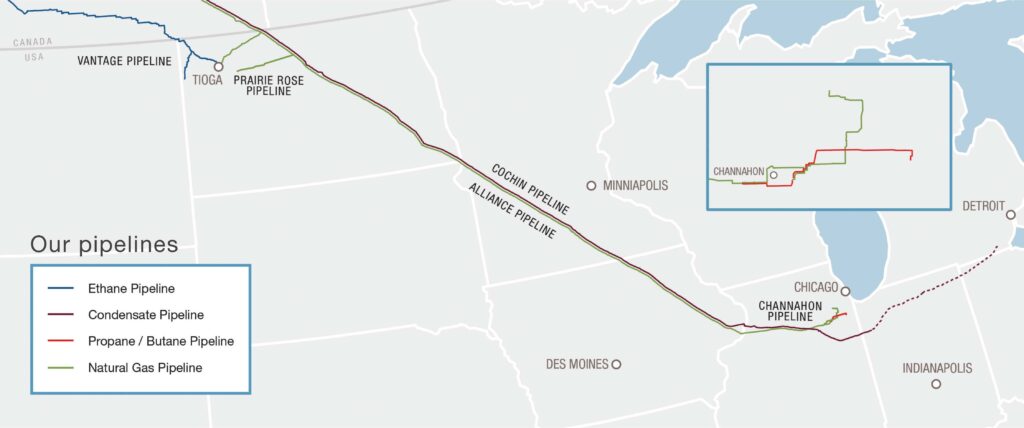
In 2019, Pembina U.S. acquired ownership of the U.S. portion of the Cochin Pipeline System, which transports condensate, from Kinder Morgan. The U.S. portion of the Cochin Pipeline System is owned and operated by Pembina Cochin LLC, an affiliate of Pembina U.S. Corporation. The U.S. portion of the Vantage Pipeline and the West Spur Lateral pipelines are high vapor pressure (HVP) pipes that transport ethane. Vantage Pipeline US LP (Vantage) is the owner and operator of the Vantage Pipeline and the West Spur Lateral. Vantage is an affiliate of Pembina U.S. Corporation.
Pembina U.S. is an indirect partial owner of Aux Sable, in partnership with Williams. Aux Sable is physically operated by a Pembina U.S. subsidiary, and includes the Channahon Pipeline, which is a HVP propane / butane pipeline, and the Prairie Rose Pipeline, which is a HVP natural gas pipeline.
The Alliance Pipeline system consists of a 2,391-mile integrated Canadian and U.S. natural gas transmission pipeline system, delivering rich natural gas from the Western Canadian Sedimentary Basin and the Williston Basin to the Chicago market hub. The system has been in commercial service since December 2000 and, through an innovative suite of customer-focused services, delivers an average of 1.6 billion standard cubic feet (or 45.3 million standard cubic meters) of natural gas per day.
What is condensate?
Condensate is a low-density mixture of hydrocarbon liquids. It is typically used in heavy oil production. Because condensate is typically liquid in ambient conditions and also has very low viscosity, it is often used to dilute highly viscous heavier oils that cannot otherwise be efficiently transported via pipelines.
What is ethane?
Ethane is a hydrocarbon that is isolated from natural gas. The petrochemical industry uses raw materials such as benzene, ethane, and propane from the oil and gas industry to manufacture products that we use every day. The Vantage Pipeline and the West Spur Lateral transport ethane, which is most commonly used to produce ethylene and polyethylene. These chemicals are needed to manufacture products like plastic, automotive antifreeze, and detergent.
What is fuel gas?
Fuel gas is a component of natural gas and is composed primarily of methane. Fuel gas is used to power natural gas engines and generators, and in various industrial applications.
What is propane/butane?
Propane and butane are hydrocarbons isolated from natural gas. The petrochemical industry uses raw materials such as propane and butane to manufacture products that we use every day. Propane and butane is used for cooking and heating. Butane is also used as a refrigerant and as propellant in aerosol cans.
PIPELINE PURPOSE, SAFETY AND RELIABILITY
Pipelines are a safe and efficient means of transporting large quantities of crude oil, natural gas and natural gas liquids.
Pembina U.S.’s pipelines and facilities are designed, constructed, and operated in a safe and environmentally responsible manner.
We know that maintaining the integrity of our pipelines is essential to the health and safety of the communities in which we operate. We conduct regular inspections, maintenance, and testing to confirm that our pipelines are operating safely. We monitor the operating conditions of the pipeline through sensors 24/7/365 from our state- of-the-art control room. We conduct aerial and ground inspections to ensure our systems are operating safely and to identify unsafe or unauthorized activity which could damage the pipe or impact safe operations.
We reinforce our commitment to excellence in safety in our daily operations by developing stringent standards and reviewing potential hazards, in addition to conducting regular safety meetings, contractor screenings, and inspections.
Pembina U.S. takes many steps to ensure safe and reliable operations which include a strict adherence to an Integrity Management Program and Damage Prevention Program, and continuous monitoring and maintenance.
RIGHT-OF-WAY
Regulations restrict certain activities near the near the Right-of-Way (ROW) or pipeline that could pose a threat to public safety and the safe operation of the pipeline.

PIPELINE MARKERS
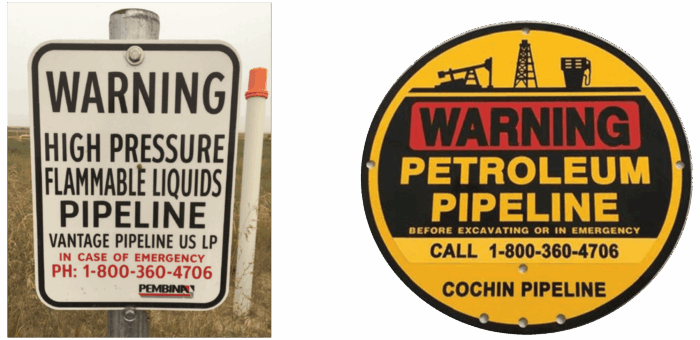
Pipeline markers are located along the pipeline right-of-way. Markers identify the area, but not the exact location or depth of the pipeline. They also specify the product transported, the operator’s name and emergency contact number. ONLY a Pembina U.S. representative can identify the exact location of the pipeline. Here are some examples of what our signage looks like.
NATIONAL PIPELINE MAPPING SYSTEM (NPMS)
The federal government also provides maps that show the approximate location of transmission pipelines in your community through the National Pipeline Mapping System at www.npms.phmsa. dot.gov. Government and safety officials can access additional information and download electronic files to import into emergency preparedness GIS mapping systems. As with pipeline markers, the map will show the approximate location of the pipeline only. A one call is still required.

WORKING TOGETHER TO PROTECT PIPELINES & RIGHT-OF-WAYS
As a public official you have an important role to play in notifying Pembina U.S. about upcoming changes to roadways, bridges, zoning and other capital projects. Advanced notice allows Pembina U.S. to work together with community planning committees and land use personnel to address impact to the pipeline or ROW.
Pembina U.S. requests that you, public and government officials, notify us when you observe potential ROW restriction violations or potential damage to our facilities, which could endanger public safety.
We support your enforcement of “Call Before You Dig” requirements in your state.
Excavation activity is the most common cause of serious pipeline damage. In most states, residents, excavators and farmers are required by law to call 811 or their local One-Call Notification Center 2-3 business days prior, or as indicated by the local One Call Center, before starting an excavation project to have underground utilities marked. Best practices encourage highway maintenance personnel and municipalities to call 811 before excavating.
UNAUTHORIZED ACTIVITY
Unauthorized Activity is any infringement of damage prevention or pipeline protection regulations (federal or state) or any activity that Pembina U.S. considers to be a hazard, trespass or risk to the pipeline.
Unauthorized building or planting in the pipeline ROW is known as encroachment. Pembina U.S. regularly conducts maintenance to trim trees and remove shrubs or structures that prohibit the company from clearly viewing the pipeline corridor during aerial or foot patrols and regular maintenance activities.
Please contact us if you know of places where trees, plants or structures are located on the pipeline ROW or if you see individuals digging in those areas.
VEHICLE CROSSING
Crossing a pipeline ROW with a vehicle, recreational vehicle or mobile equipment may require permission from Pembina U.S. Contact us to ensure your activity is permitted on the pipeline ROW.
LAND USE PLANNING
Industrial, residential and commercial development that encroaches on the pipeline ROW can present safety and operational risks to those working and living nearby. This growth may impact the operational requirements of our existing pipelines, such as changes to operating pressure, revisions to our emergency response plans, increased public awareness outreach and other actions. This is why it’s crucial to consult early in the planning stage of a project on or near Pembina U.S. assets. Consultation allows affected parties to better incorporate existing pipelines and facilities into the plan, making sure that new development meets both regulatory and Pembina U.S. requirements, while also maintaining high standards for public safety.
PLANNING AND ZONING DEPARTMENTS: LAND DEVELOPMENT NEAR PIPELINES
As municipalities grow, more housing and commercial developments are built near pipelines and related facilities. Public officials involved in planning and zoning can help by verifying that land developers submit plans showing the accurate location of nearby pipelines and other buried utilities at the proposed site.
If you see someone digging or disturbing the soil and there are no flags or marks on the ground, please stop the activity and ask the person to call 811 before continuing. Do not rely on word-of-mouth, maps, memory, or pipeline markers when planning a digging project.
Pembina U.S. will work with zoning departments to determine if the land developer:
- has considered the need for ROW access and evacuation routes to be used in the unlikely event of an emergency
- will take steps to prevent excavation damage to buried utilities during construction
- has considered alternative uses for the pipeline ROW such as public spaces.

PLANNING WORK AROUND PIPELINES
Some of the biggest threats to pipeline safety come from unauthorized construction, development, encroachment and digging activities. Notifying Pembina U.S. and your local One-Call Centre are your first steps to preventing damage to underground infrastructure and working safely around pipelines.
Pembina U.S may require a written consent before the following activities can occur:
- construction of a facility across, on, along, or under a pipeline (including the ROW)
- ground disturbance activities (excavation or digging)
- operation of a vehicle or mobile equipment across a Right-of-Way (ROW) or pipeline, outside the travelled portion of a highway or public road
- using explosives within 300 meters or 1,000 feet of Pembina U.S.’s pipeline Right-of-Way (ROW) or pipeline
- any activity that the company deems may negatively impact the safety of the pipeline
Always have a copy of your agreement onsite. It informs us of your activity and allows us to provide guidance to prevent incidents or damage to our pipelines.
HOW TO OBTAIN WRITTEN CONSENT
Steps to obtain written approval from Pembina U.S.
- Email landrequests@pembina.com with your name, legal land description, and a description of the work you would like to do.
- Pembina U.S. will contact you and walk you through how to submit a request for permission to proceed with your activity in, along or adjacent to the Right-of-Way (ROW) or pipeline.
- Pembina U.S. will review your request once your information has been received. Pembina U.S. may:
- grant consent with standard conditions
- grant consent that requires specific conditions be met to ensure safety
- work with you to find solutions and resolve issues regarding the consent request
- deny consent in the rare situation that a feasible safety solution cannot be found.
- Once consent has been granted, you must:
- make a locate request to your local One Call Notification Center at least 2-3 business days, or as indicated by your local One Call Notification Center, before beginning the work. Pembina U.S. will arrange for a Company representative to be on site to inspect the area at time of crossing.
- always keep the written consent and documentation onsite.
- follow all terms and conditions laid out in the consent, and all instructions from Pembina U.S. personnel onsite
IMPORTANCE OF DEPTH OF COVER
Depth of cover (DOC) is the vertical distance between the top of the pipeline and the surface of the ground. It is crucial for protecting both the pipeline and the interests of landowners. Adequate depth ensures the pipeline is shielded from surface activities like agricultural activity, construction, or heavy equipment traffic, reducing the risk of accidental damage and potential safety hazards.
If you are aware of areas where DOC has changed due to erosion, construction activities, or farming practices, please contact us at DPPA@pembina.com or 1-800-920-1979.
EMERGENCY & CONTINUITY MANAGEMENT PROGRAM (ECMP)
Although rare, emergencies can occur. To prepare for these instances, Pembina U.S. participates in an Emergency & Continuity Management Program (ECMP), which includes comprehensive standards and processes to support the safety of the public, our workers and the environment.
The ECMP evaluates potential hazards from our operations as well as other hazards such as security breaches and natural disasters. Our comprehensive evaluation provides the foundation for our approach of prevention, planning, response and recovery. This approach allows for a safe and effective response to an incident. Emergency Response Plans (ERP) are maintained for Pembina U.S.’s facilities and products. These plans identify the organizational structure, equipment, and resources necessary to ensure that actions are taken for the protection of the public, employees and the environment. Pembina U.S. conducts ongoing responder training, exercises, and public consultation to ensure continuous improvement of our plans and program and that our personnel are ready to respond to emergencies.
KNOW THE WARNING SIGNS
Although rare, it is important to know the warning signs of a pipeline release:

You might see:
- dead or dying vegetation in an otherwise green area
- dirt being blown or appearing to be thrown into the air
- a white vapor stream or mist-like cloud over the pipeline
- unexpected frost or ice on the ground
- discolored snow or vegetation
- a moist patch or pool of clear, light brown or yellow liquid
You might hear:
- an unusual hissing, blowing or roaring noise
You mights smell:
- a petroleum or hydrocarbon smell similar to gasoline or diesel fuel
HOW TO OBTAIN MORE INFORMATION ABOUT PIPELINES
The National Pipeline Mapping System (NPMS) is an on-line mapping tool available to the public that enables you to view information on transmission pipelines that are under Department of Transportation (DOT) and Pipeline and Hazardous Materials Safety Administration (PHMSA) jurisdiction. By accessing the NPMS, you can view information on a county by county basis and obtain information on which transmission pipelines operate in your community. You can also obtain contact information for pipeline operators in your area. The NPMS can be accessed here: npms.phmsa.dot.gov
Remember: The NPMS is not to be used to identify exact locations of pipelines. You must contact your local One-Call system before you start any digging activities.
IF YOU SUSPECT A RELEASE
You are our partner in safety
In the unlikely event of an emergency, Pembina U.S. will shut down the pipeline (if necessary) and activate our Emergency Response Plans.
What to do:
- abandon any mechanized equipment and move as far away from the leak as possible, avoiding contact with escaping liquids and gases
- call 9-1-1
- call Pembina U.S.’s emergency line that you see on a pipeline marker
- follow instructions provided to you by Pembina U.S. and local emergency responders
What you shouldn't do:
- do not touch or go near any liquid, gas or vapor cloud do not start your vehicle or any equipment that could be a potential ignition source
- do not smoke or light a match, and avoid heating sources or making sparks
- do not turn on or off anything that may create a spark, including cell phones, pagers, flashlights, keyless entry remotes, vehicle alarms, and light switches, until you are in a safe location
- do not attempt to operate or turn pipeline valves
- do not attempt to extinguish any flames or fire
- do not remain in a building if the smell is stronger inside than outside
What happens next:
- Public safety is top priority while Pembina, contractors and local emergency responders work together to evaluate and respond to a pipeline leak
- Local emergency responders oversee public safety measures including securing the scene, providing medical aid and other lifesaving services and getting you the information you need to stay safe
- Pembina will work with applicable agencies to remediate any impacts caused by the leak

24 HOUR EMERGENCY LINE: 1-800-360-4706
Emergency number for Aux Sable, North Dakota: 701-628-9393
Emergency number for Aux Sable, Illinois: 815-941-5858
Emergency number for Alliance (US & Canada): 1-800-884-8811
If you notice any unusual or suspicious activity on or near the pipeline or Right-of-way (ROW), please report it by calling 9-1-1 and Pembina U.S.'s 24-hour emergency number above.
CALL BEFORE YOU DIG: 8-1-1
Questions about pipelines in your community?
If you have any questions, please connect with us in any of the following ways:
Community Relations
Phone Toll Free: 1-888-920-1979 (non-emergency calls)
email: community@pembina.com
Pembina U.S.
1300 Post Oak Blvd, Suite 1050 Houston, TX 77056
Toll Free: 1-888-428-3222